Thyroid Nodule Ultrasound TI-RADS
Reference Images
Scoring
Five categories
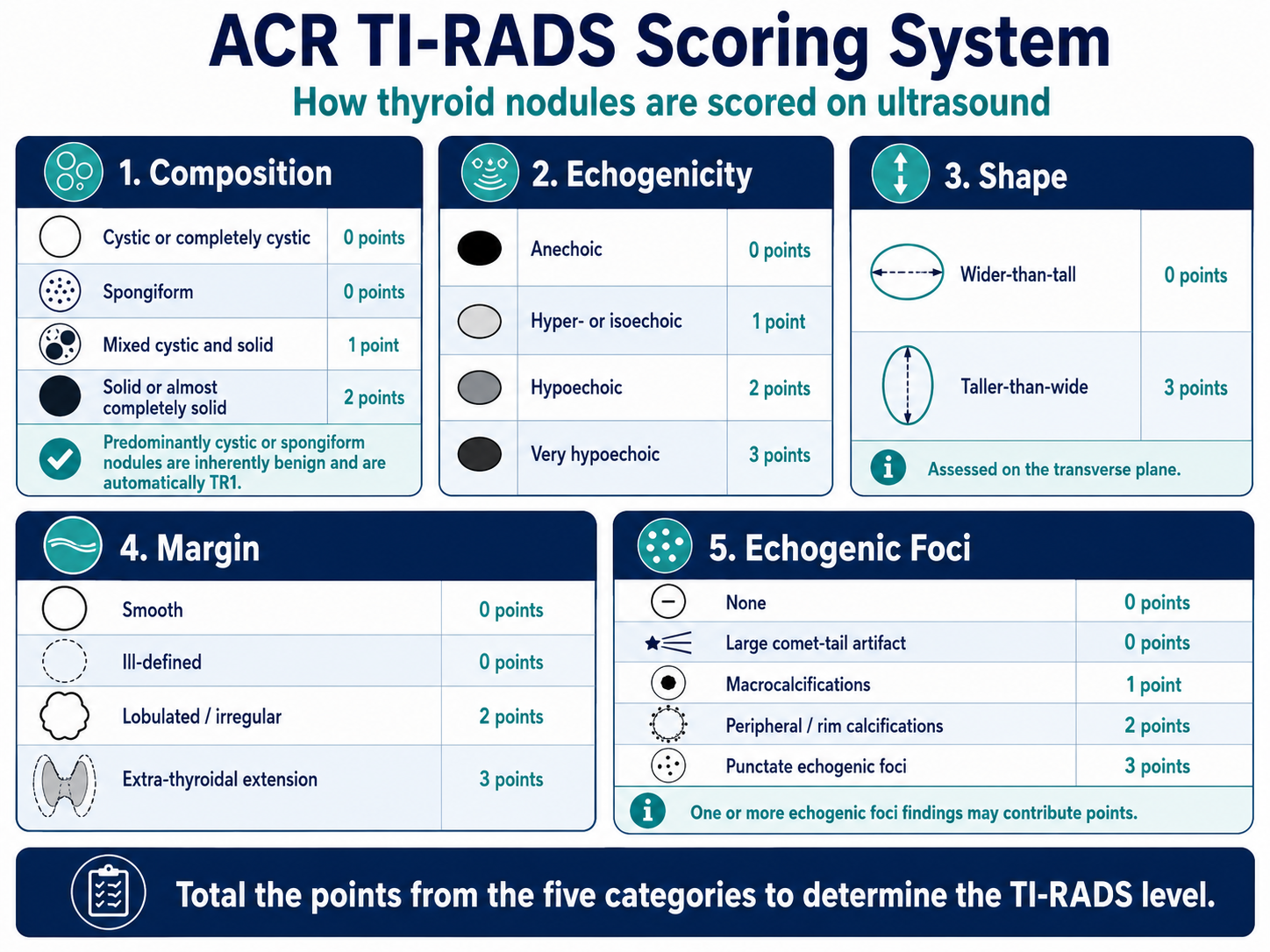
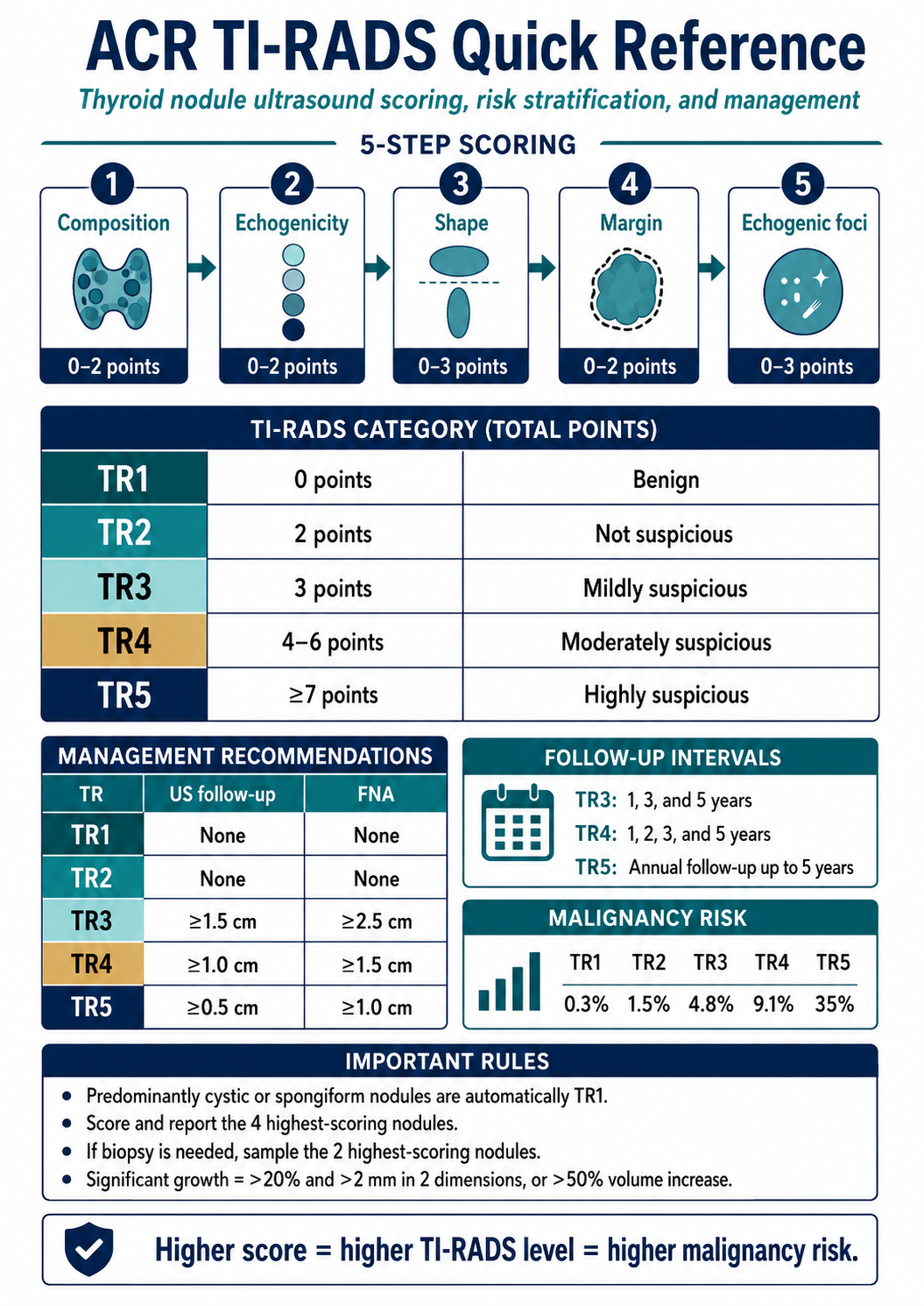
Assign points for composition, echogenicity, shape, margin, and echogenic foci; total points determine TR1-TR5.
Feature points
- Composition: cystic/spongiform 0; mixed cystic-solid 1; solid/almost solid 2.
- Echogenicity: anechoic 0; hyper/isoechoic 1; hypoechoic 2; very hypoechoic 3.
- Shape: wider-than-tall 0; taller-than-wide 3, assessed on the transverse image.
- Margin: smooth or ill-defined 0; lobulated/irregular 2; extra-thyroidal extension 3.
- Echogenic foci: none or large comet-tail 0; macrocalcification 1; rim calcification 2; punctate echogenic foci 3.
Category
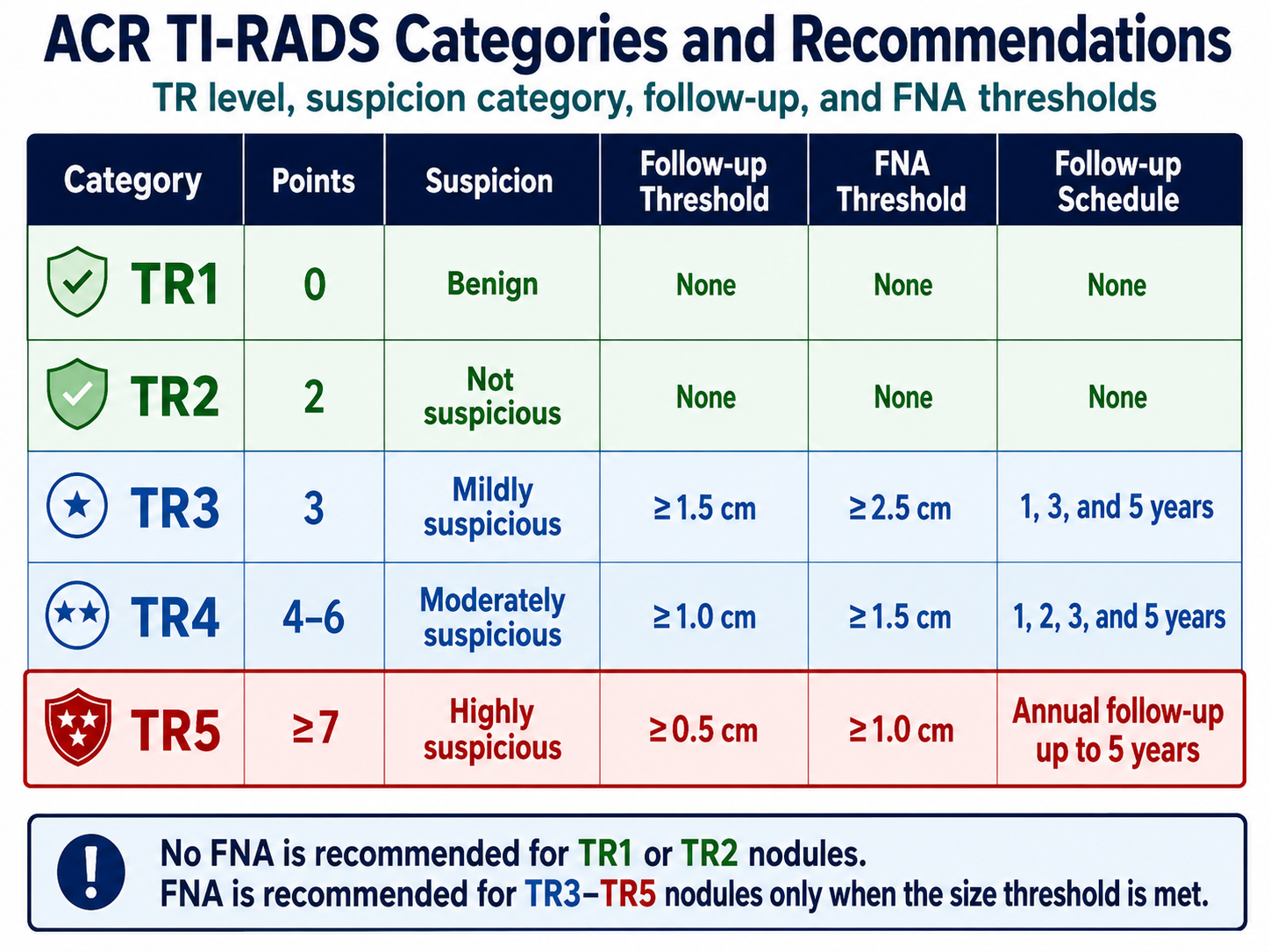
- TR1: 0 points, benign.
- TR2: 2 points, not suspicious.
- TR3: 3 points, mildly suspicious.
- TR4: 4-6 points, moderately suspicious.
- TR5: 7 or more points, highly suspicious.
- Predominantly cystic or spongiform nodules are considered benign patterns and are automatically TR1.
Follow-Up / FNA
Bottom line
TR1 and TR2 need no follow-up or FNA. TR3-TR5 management depends on both TI-RADS level and size.
Thresholds
- TR3: follow at 1.5 cm or larger; FNA at 2.5 cm or larger.
- TR4: follow at 1.0 cm or larger; FNA at 1.5 cm or larger.
- TR5: follow at 0.5 cm or larger; FNA at 1.0 cm or larger.
Follow-up schedule
- TR3: ultrasound at 1, 3, and 5 years.
- TR4: ultrasound at 1, 2, 3, and 5 years.
- TR5: annual ultrasound up to 5 years.
Approximate malignancy risk
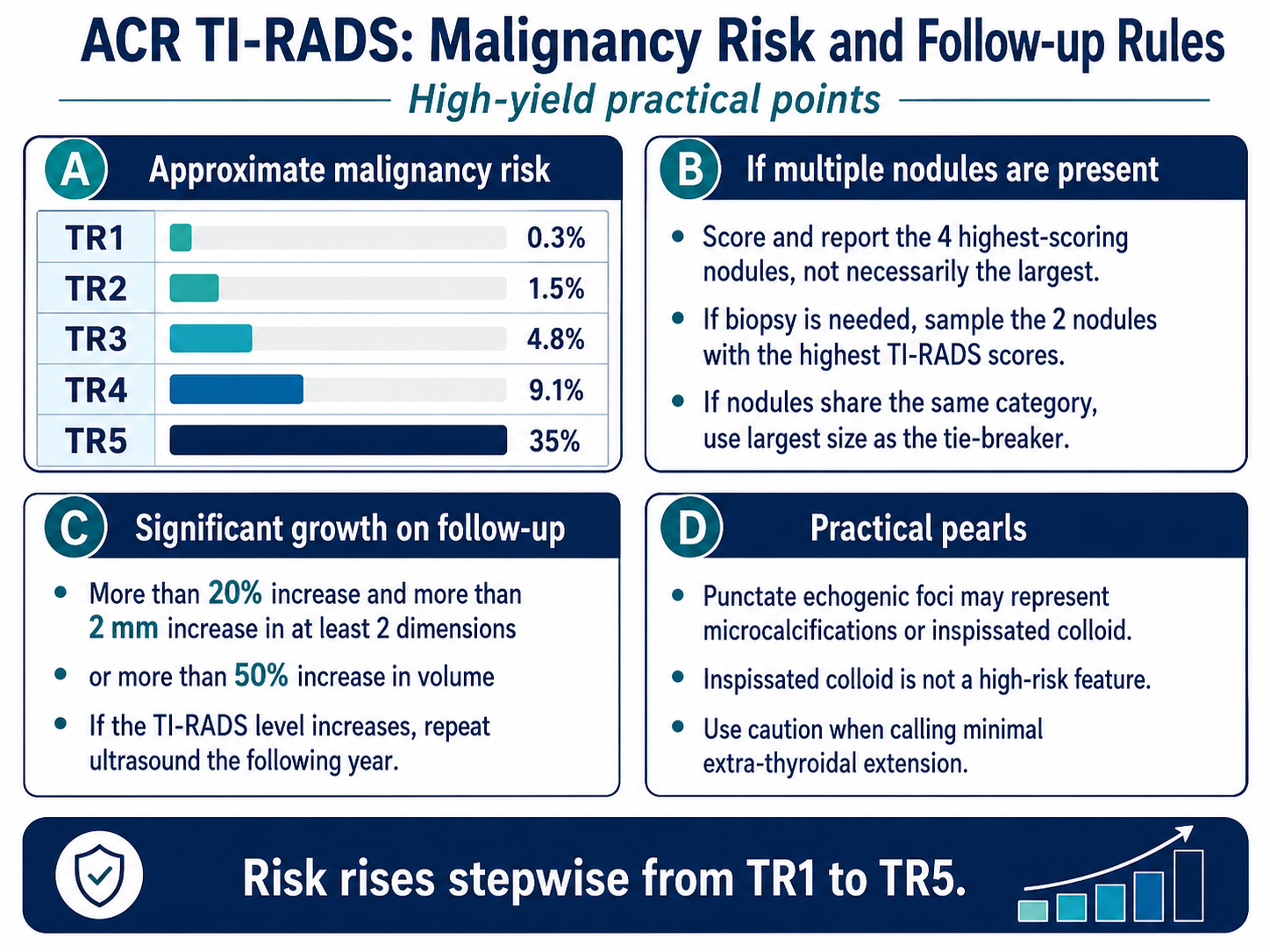
- TR1: 0.3%; TR2: 1.5%; TR3: 4.8%; TR4: 9.1%; TR5: 35%.
Reporting Pearls
Multiple nodules
- Score and report the four highest-scoring nodules, not necessarily the four largest.
- If biopsy is needed, sample the two nodules with the highest TI-RADS scores.
- If nodules have the same TI-RADS category, use largest size as the tie-breaker.
Significant growth
- More than 20% increase and more than 2 mm increase in at least two dimensions.
- Or more than 50% increase in volume.
- If TI-RADS category increases on follow-up, repeat ultrasound the following year.
Pitfalls
- Punctate echogenic foci may be true microcalcifications or inspissated colloid; colloid is not a high-risk feature.
- Frank invasion of surrounding structures gets extra-thyroidal extension points, but subtle/minimal suspected extension should be interpreted cautiously.